Please note: this story was provided by the author and published as is.
I don’t know how to start this.
I’ve been sitting here for three weeks trying to find the right words and I keep deleting everything I write. My physical therapist says writing things down might help. She means like a journal. She doesn’t mean this. But here I am anyway, because I need someone besides me to know what happened on that stretch of highway south of Gainesville. I need someone to believe me. I’m not sure you will. I wouldn’t.
My name is Earl Pruett. I’m fifty-two years old. I’ve been driving long-haul for twenty-six years, which means I’ve put more miles on me than most cars ever see. I live in Knoxville, Tennessee. I live alone since my wife Sandra left in 2019 — not because anything dramatic happened, but because nothing dramatic ever happened and she got tired of waiting for it. I don’t blame her. I have a daughter named Cassie who calls me on Sundays when she remembers. I have a cat named Bruiser who is not actually mean at all.



I tell you all of this because I want you to understand that I am not the kind of man who imagines things. I am not a superstitious man. I don’t watch horror movies. I think ghost stories are for children. I say all of this because of what I’m about to tell you.
The run was supposed to be simple.
I transported human remains.
Not in the way you’re thinking. Nothing illegal. Nothing gruesome — or, well. Not in the way most people think of gruesome. I worked a specialty freight contract with a logistics company out of Knoxville that coordinated body donation programs. When someone dies and donates their body to medical science, someone has to move that body to the university or research center where it’s going to be used. That someone, for the better part of five years, was often me. Refrigerated cargo unit in the back. Proper manifests. All above board. I signed NDAs and everything.
You get used to it. That’s the honest answer when people ask how I did it. You just get used to it. They’re not people anymore, not in the way that matters to the living. They’re donations. Contributions. I respected that. I treated every run like I was carrying something important, because I was.
The pickup was in Harrisburg, Pennsylvania. A regional medical center that partnered with a body donation network. My contact up there was a man named Gerald, forties, always wore a fleece vest no matter the weather. He met me at the loading dock, we did our standard paperwork, the cargo was loaded, and I was on my way south by seven in the morning on a Tuesday in late October.
And here’s the thing. The thing I keep coming back to. Gerald handed me my manifest and we both signed it and I folded it and put it in my glovebox and I did not read it carefully. I was tired. I’d been on the road since four that morning, deadheading up from a drop in Baltimore. I had coffee. I had a breakfast sandwich from a gas station that I regretted within the hour. I had fourteen hours of driving ahead of me and a delivery window the next morning at the University of Florida College of Medicine.
I did not count the bodies. I did not verify the number against the manifest. I just drove.
That’s the part I’ll carry the rest of my life.
The first eight hours were fine. Fine is boring. Fine is the whole job, usually. I came down through Virginia and into the Carolinas, stopped for fuel and lunch outside of Santee, got back on I-95 and made the cut west toward I-75 south of Jacksonville. By the time I crossed the Florida state line it was just past six in the evening and the sky had gone the color of a bruise.
I want to be clear about something. I had slept well the night before. I wasn’t running on fumes or pushing through fatigue warnings the way guys do when they’re chasing miles. I was tired the way you’re tired after eight hours of highway driving — that low, dull kind of tired that sits behind your eyes but doesn’t threaten you. I’ve driven through worse. I know my limits.
Or I thought I did.
It started around Alachua County. That’s what I keep telling people and that’s what they keep not understanding, because to most people Alachua County is just another stretch of Florida interstate — flat, dark, lined with live oaks draped in Spanish moss that hang over the highway like fingers reaching for the road.
But truckers know. If you run I-75 south of Gainesville regular enough, you start to hear things. Not ghost stories the way civilians tell them — not floating white ladies and rattling chains. Trucker ghost stories are different. They’re practical. They’re about what happened to a guy you almost know, a friend of a friend, someone who drove for a different company but ran the same corridor.
The thing about that part of Florida is that the land itself doesn’t behave. Paynes Prairie sits just south of Gainesville — a big flat wetland basin, part of a state preserve, and the highway runs right across the top of it on a long causeway. Four hundred years ago it was a lake. Then it drained. Then it flooded again. Then it half-drained. It can’t decide what it is. And on foggy nights, drivers say the prairie gives things back.
I’d heard the stories the way you hear all the stories on the road — passed between men at truck stops, told in the particular flat voice that means the teller is trying to sound like he doesn’t believe it. A driver sees a figure walking the shoulder of the causeway in fog so thick you can’t see the guardrail. He slows down. It doesn’t turn around. It just keeps walking, same pace, same direction, regardless of whether he speeds up or slows down or flips his brights. And then the fog closes in and it’s gone.
Multiple drivers. Multiple years. Always the same stretch. Always the same fog.
I’d also heard the one about the hitchhiker outside of Micanopy — picked up after midnight, rides twenty or thirty miles, talks the whole time about local roads and local history like someone who’s been walking this land for a very long time, and then the driver looks over at a rest area and the seat is empty. Door never opened. No sign they were ever there.
And I’d heard about the CB static. A specific dead zone just north of the Williston Road exit where your radio goes to white noise and, if you’re unlucky, you hear something underneath it. Not words. Just breathing. Slow and even, the way you breathe when you’re asleep. Or when you’ve been asleep for a very long time.
I’d filed all of it away under the usual category: exhausted men, empty roads, overactive imaginations. That’s always the answer. That was always enough.
It was on the causeway, somewhere over the black water of the prairie, that I thought about Lavinia Fisher.
I don’t know why she came to me then. She doesn’t belong to this part of Florida. She’s a South Carolina ghost — Charleston, early 1800s. She and her husband ran a roadhouse outside the city and the story goes she had a way with traveling men. She’d invite them in, offer them hospitality, and by morning the guest room was empty and the ground out back was a little less even than it had been. She was hanged in 1820 and she went to the gallows in her wedding dress and her last words were something about carrying messages to the devil.
That’s the line that travels. That’s why truckers know her name.
But she’s one of many. That’s what I’ve come to understand since that night. This stretch of Florida — this particular corridor of highway, this basin of old water and fog — it collects them. Whatever Lavinia Fisher became after 1820, she’s not alone down here. The prairie draws wandering things the way low ground draws water. You drive through it enough times and you start to feel it, that sense that the road you’re on is older than the asphalt, that the things moving through the dark alongside you have been moving through this dark for a very long time.
I didn’t believe any of that when I crossed the causeway that night.
I believe it now.
I started to fall asleep somewhere around mile marker 384.
Not the hard, sudden kind — not a wall hitting you. The soft kind. The gradual kind. The kind that’s dangerous precisely because it doesn’t announce itself. It comes in layers. First your eyes feel heavier than they should. Then the road starts to look a little longer, a little more hypnotic, the center line becoming something rhythmic rather than informational. Then the sounds in the cab shift and they blend together into something almost musical, almost comfortable.
I turned the radio up. I cracked the window. Cold October air hit me and I blinked and felt sharp for about ten minutes and then the sharpness bled away again.
That’s when I couldn’t remember the number.
I’d been tired when I signed the manifest. I’d folded it and put it in the glovebox without reading it and now I was on a causeway over a black wetland in the dark and I could not remember what number was on that paper. I reached for the glovebox.
That’s when I felt the truck drift.
Small — just a few feet, just a gentle lean toward the shoulder. I corrected it without thinking, the way you do after twenty-six years, muscle memory taking over. And then I heard something.
From behind me. From the cargo unit.
Refrigerated cargo units are not quiet. The compressor runs constantly, a low mechanical drone you stop hearing after the first hour. Road noise, engine noise, wind noise — there is always sound in a truck cab.
What I heard was underneath all of that. Three taps on the inside wall of the unit. Slow. Deliberate. Evenly spaced.
I told myself it was cargo shift. I told myself a strap had worked free, something had settled. I was reaching for that explanation the way you reach for a light switch in the dark — desperate, automatic — when I heard it again.
Three more taps.
Slower this time.
And then — I don’t know how else to say this — a long, slow drag. Like something was pulling itself along the inside wall of the unit. Fingernails, or what had once been fingernails, drawing a single unbroken line from one end of the cargo space to the other.
I have driven through tornadoes. I have driven through ice on a mountain pass with a forty-foot trailer behind me. I have never, in twenty-six years, felt fear the way I felt it in that moment — not the sharp kind, not adrenaline, but the deep cold kind, the kind that starts in the center of your chest and spreads outward until your hands go numb on the wheel.
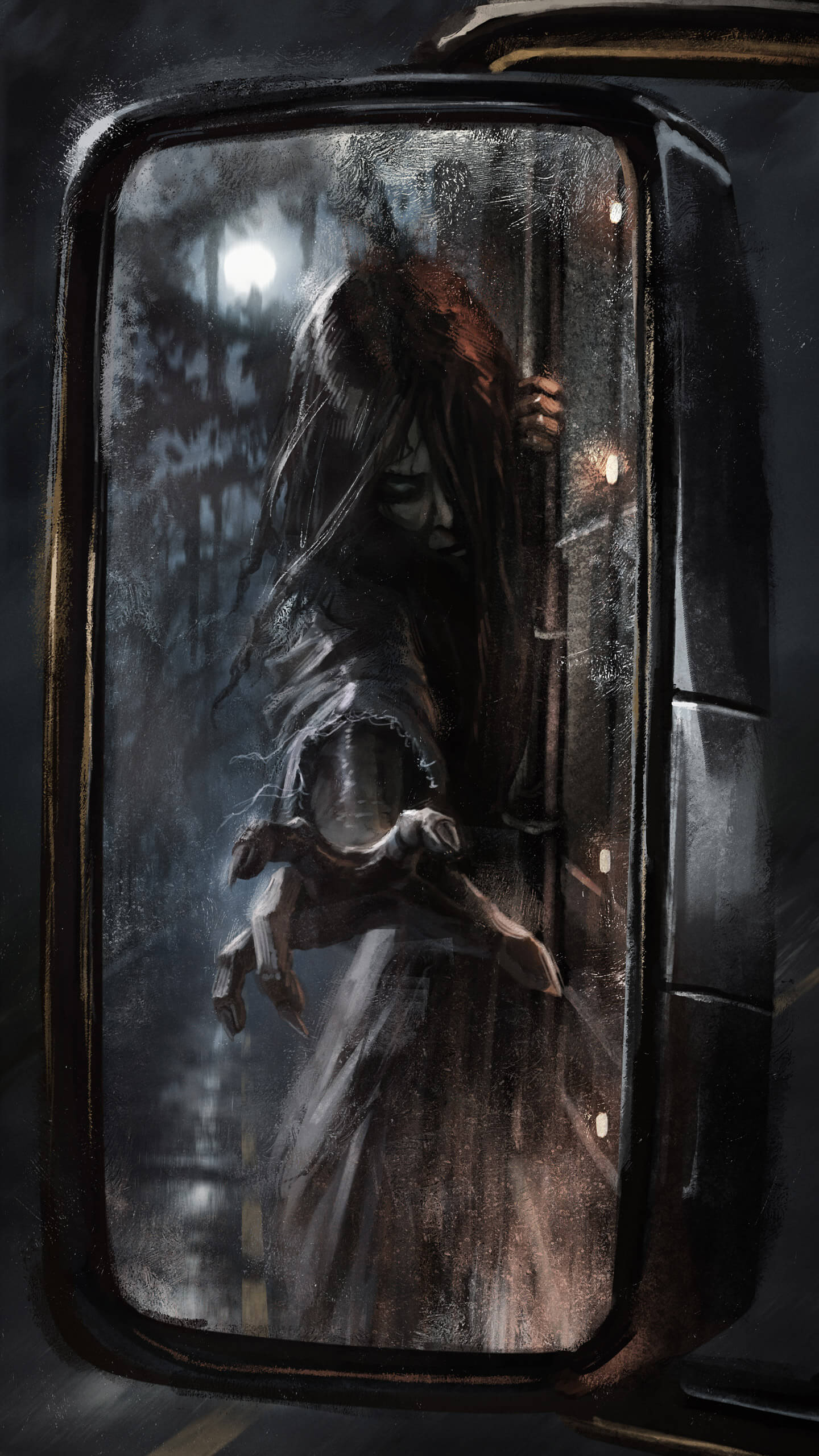
I looked in my side mirror.
I don’t know what I expected to see. Road behind me. Dark. Fog.
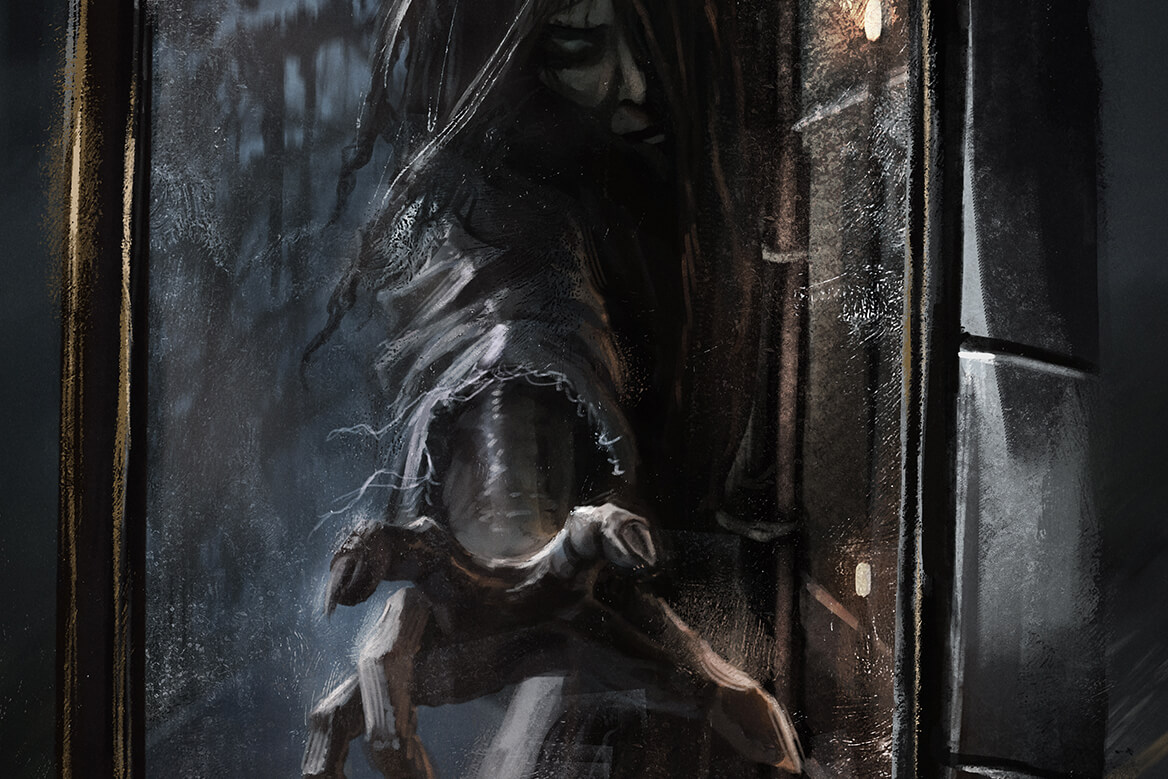
What I saw was a shape at the rear corner of the cargo unit.
Not outside the truck. Not on the road behind me. At the corner. Like something had come around from inside and was pressed against the exterior, riding the side of the unit in the dark, and it was looking at the mirror.
It was looking at me looking at it.
I can’t tell you what it looked like. I can tell you it was pale. I can tell you the proportions weren’t right — too long in some places, not right in others, the way a thing looks when it has learned the shape of a person but hasn’t quite gotten it. I can tell you that for one full second I held eye contact with something in my side mirror that had no business being on the outside of my truck at sixty-five miles an hour on a causeway over a Florida wetland at nine at night.
Created by: Danny Ingrassia
And then I yanked the wheel.
Too hard.
The truck came back onto the road and kept going, left, crossing the center line, and I overcorrected and felt the trailer start to do the thing trailers do when you overcorrect at speed — that slow, terrible pendulum swing, the back end wanting to go one way while the cab wanted to go another. I was doing sixty-five. The causeway had no shoulder worth speaking of. On either side of me was the darkness of Paynes Prairie dropping away below the road’s edge.
I remember the sound the tires made. I remember my hands on the wheel. I remember the trailer swinging and the cab tilting and then a sound like the world tearing itself in half.
And then nothing.
* * *
I came back once before the paramedics reached me. I don’t know how long it was. Seconds, maybe. Maybe less.
I was on my side. The cab was on its side. Glass somewhere. The smell of coolant and wet grass and something else underneath it, something cold and chemical, the specific smell of the refrigeration unit.
The cargo doors were open.
Not broken open. Not torn off by the impact. Open. The way a door opens when someone turns a handle.
I couldn’t move my head. I couldn’t move anything. But I could see through the gap where the windshield had been, out onto the road surface, lit by one remaining headlight that was somehow still alive, throwing a long pale beam across the pavement.
There was a figure in the light.
Standing at the open doors of the cargo unit. Still. Facing away from me. Whatever it was, it was dressed in something that caught the light wrong — too bright, too white, the kind of white that belongs to other eras. Its head was turned just slightly, at an angle that suggested it was aware of being watched.
It did not move. It did not run. It simply stood there at the open doors of my cargo unit, in the headlight beam, on a causeway over Paynes Prairie, with all the patience of something that has been waiting a very long time and has nowhere better to be.
Then it turned its head toward me.
And I went back into nothing.
* * *
I woke up in UF Health Shands Hospital in Gainesville. Broken ribs. Fractured wrist. A concussion they called moderate but felt like someone had replaced my brain with wet sand. The paralysis I’d felt at the scene — the total inability to move — had resolved by the time I was admitted. They called it spinal shock. Temporary. My spine was bruised but intact.
They told me I was lucky.
I told them I understood that. I did not tell them everything I understood.
A detective came to ask about the accident. I told him I’d seen something in my side mirror and swerved. He wrote that down without looking up. He asked if I’d been drinking. I said no. He asked if I’d been on the road too long. I said I was within my hours. He nodded and left.
On day three, a man from the logistics company came. Very calm, very professional. He said there had been a documentation discrepancy at the point of pickup. He said it had been corrected. He said he hoped I understood these things happen.
I asked him what the manifest had said.
He said the matter was under review.
I asked him about the cargo doors. Whether the investigators had noted how they’d been opened.
He looked at me for a moment and then he looked at his folder and he said he couldn’t speak to the specifics of the scene report.
I did not sign the paper he left with me.
I called Gerald in Harrisburg four times over the following two weeks. He never called back. I tried the main number for the Harrisburg facility on day twelve and was told that Gerald no longer worked there and that they couldn’t discuss specifics of past freight arrangements.
My copy of the manifest was destroyed in the crash.
The investigators told me, through the logistics company’s representative, that the discrepancy in the count at the scene had been attributed to a processing error at pickup. They said the official count on delivery was correct. They said the matter was closed.
They did not tell me what the official count was.
They did not explain the cargo doors.
I’ve been home for six weeks now. Bruiser sleeps on my feet. Cassie calls more than Sundays. My physical therapist says I’m making excellent progress.
I don’t drive anymore. Not for work. Not long distances. I sit in the house I didn’t want and I think about Paynes Prairie and the fog that comes up off the water and the stories that get passed between tired men in the dark.
Here’s what I think happened. Not what I can prove. What I think.
I think that stretch of Florida collects things. I think the roads there are older than the roads, if you understand what I mean by that — I think whatever moves through that land at night has been moving through it longer than there have been highways to move on. I think they’re drawn to the corridor the way they’ve always been drawn to roads, to travelers, to men moving alone through the dark carrying things.
I think something got on my truck.
I think it tapped on the wall to make sure I wouldn’t pull over and count.
I think it showed itself in my mirror because it wanted me to crash. Because it needed the chaos of the crash to cover what it was doing at those cargo doors.
I think the eighth body — whatever was on my manifest that shouldn’t have been — was misplaced at the scene in the confusion after the crash. I think the responding units, the first responders, the scene documentation — I think in all of that noise and urgency, something slipped through. Got counted wrong, or not counted at all, or counted and then not found.
I think it moved on.
I don’t know where. I don’t know what it wanted at the University of Florida, or whether Gainesville was a destination or just a waypoint. I think about those stories — the hitchhiker who knows too much about the local roads, the figure on the causeway that walks the same direction as traffic and never turns around. I think about how many drivers have passed through that corridor in the last hundred years and how many of them heard something they couldn’t explain and filed it under exhaustion and kept going.
I think the roads through that part of Florida have been a transit route for a very long time.
And I think I was carrying a passenger who’d been waiting for exactly this kind of run. Sealed cargo. A driver who didn’t count. A foggy night on a causeway with water on both sides.
The perfect conditions.
I came back once between the crash and the rescue and I saw it standing at my cargo doors in the headlight beam and it turned its head toward me and that’s the last thing I remember before the hospital.
I’ve told this to two people in my life. My daughter Cassie, who listened carefully and then said she thought I should talk to someone. And now you.
Maybe Cassie’s right. Maybe the concussion did something to my memory. Maybe the paralysis, the shock, the cold of the cab — maybe all of that manufactured something my brain needed to explain why it swerved.
Maybe.
But I need you to understand that I am a man who has driven a million and a half miles in twenty-six years. I know what I saw in that mirror. I know what I heard in that cargo unit. I know the cargo doors were open when they had no reason to be open.
And I know the count was wrong.
If you drive through Alachua County at night — and I mean especially if you drive through it at night, on the causeway, over the prairie, in the fog — keep your windows up.
Don’t stop for anyone on the shoulder.
And if something moves in your mirror that doesn’t have any business moving, you keep your hands steady on the wheel.
You do not swerve.
I’m telling you because I need someone to know.
I was counted among the dead.
And whatever used my truck to get where it was going — I don’t think it’s done traveling.